
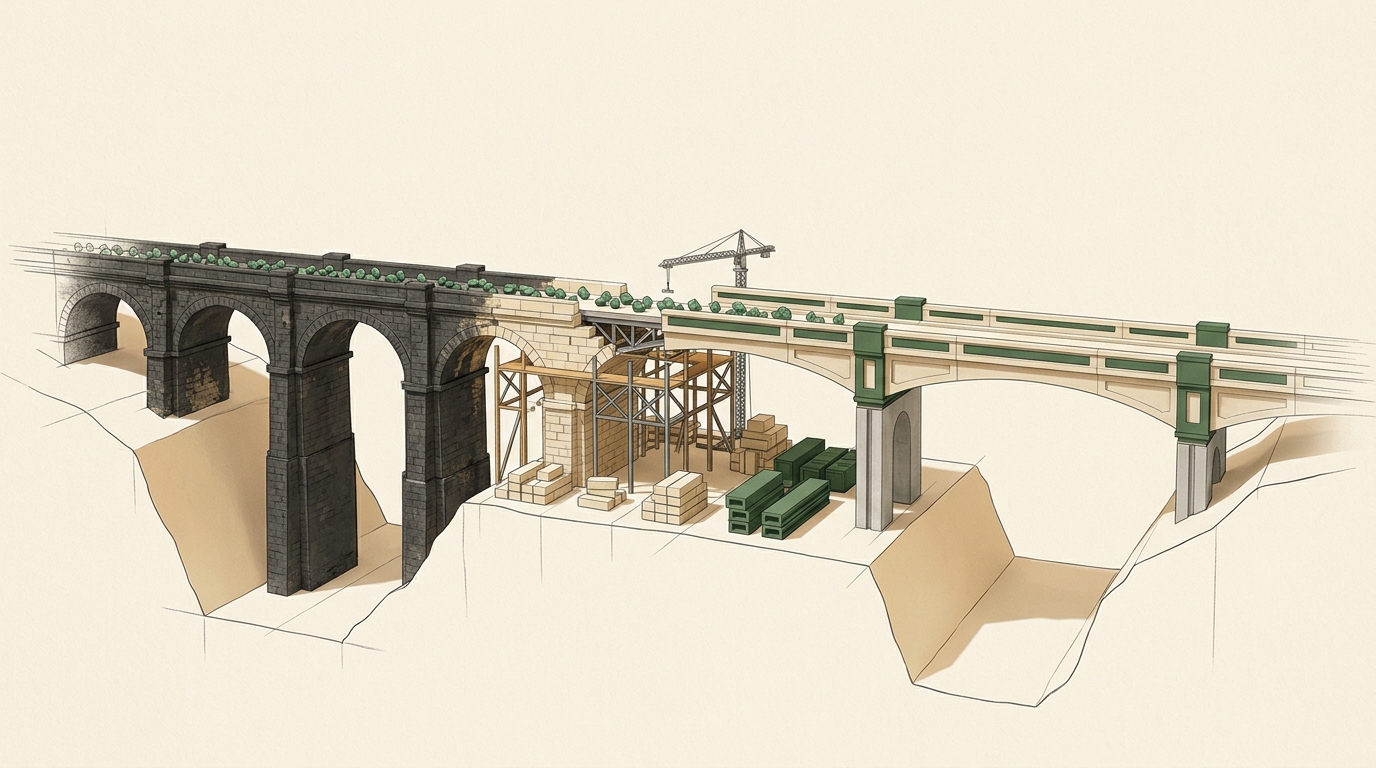
Modernize incrementally when the business core still works, the data remains usable, and problems can be isolated. Consider a rebuild when every change crosses a fragile architecture, the technology is unsupported, or the data model prevents the product from serving its next mission.
Code age does not decide the question by itself. A ten-year-old application can be stable and profitable; a recent one can already be hard to change. The decision should compare operational risk, delivery speed, status quo cost, and the ability to migrate without interrupting service.
Start with the business symptom
“The app is old” describes a perception, not a problem to solve. Look for observable consequences instead:
- a simple change takes several weeks;
- releases regularly create regressions;
- one vendor or developer is the only person who understands the system;
- employees copy the same data between tools;
- customers abandon a slow or incompatible journey;
- a security or platform requirement can no longer be met.
Measure the frequency and cost of these events. A modernization decision becomes stronger when it targets a specific result: shorter release lead time, one duplicate entry removed, support for a new device, or access to data that was previously trapped.
Five options between doing nothing and rebuilding everything
The conversation should not be limited to maintenance versus a total rebuild.
Stabilize
Fix critical incidents, add monitoring, document dependencies, and secure backups. This fits an important system with poor visibility. It creates the conditions for a more ambitious decision.
Repair and clean up
Update priority dependencies, add tests around critical journeys, and remove clearly unused code. This reduces risk without changing the product's purpose.
Replatform
Move the application to supported infrastructure or a supported technology base while retaining most behaviour. Replatforming addresses operational risk, but it does not automatically correct a poor workflow.
Refactor by domain
Isolate one capability (billing, authentication, search, or the customer portal) behind a clear interface, then replace it gradually. This preserves service and distributes risk.
Rebuild
Create a new product when the problem reaches the fundamental structure, use cases, and future direction. A rebuild is justified only when the new scope is better defined than the old one. Reproducing every screen and exception recreates the same debt in newer technology.
When incremental modernization is better
Modernize when:
- the product still fulfils its main purpose;
- the data model can support future needs;
- failures are concentrated in a few components;
- operations cannot pause for a full migration;
- the team can protect critical journeys with tests;
- a targeted improvement can deliver a measurable result quickly.
Google Cloud describes an incremental approach that first selects a business outcome, modernizes part of the system, and measures the effect before continuing. This prevents a technical project from becoming an endless program.
When rebuilding becomes more reasonable
A rebuild deserves serious investigation when several signals appear together:
- the core technology is no longer maintained or blocks security updates;
- every feature requires a risky cross-cutting change;
- there are no reliable tests or reproducible environments;
- the data model no longer represents the business;
- the application must serve a new channel, customer, or business model;
- maintenance cost rises without improving the experience;
- essential knowledge has disappeared and cannot be restored incrementally.
One obsolete dependency does not necessarily require a rebuild. Conversely, a fresh interface cannot rescue a system whose data and rules have become incoherent.
Mobile platforms set their own pace
A mobile application must follow store, operating system, and device requirements. Google says that starting August 31, 2026, new apps and updates must target Android 16, with certain format-specific exceptions. The Google Play target API requirements make the risk of an unmaintainable stack concrete.
The App Store Review Guidelines also evolve; the page showed a June 8, 2026 update when this analysis was prepared. A maintainable mobile base must accommodate continuous change. Waiting for a rejected submission sharply narrows the available options.
Score the system before deciding
Rate each dimension from low to high and attach evidence.
- Operational criticality. How much work stops if the system fails?
- Change frequency. How often must the business modify the product?
- Delivery reliability. How much time and how many incidents accompany a release?
- Data health. Is data consistent, exportable, and understood?
- Available knowledge. Can the team explain rules and dependencies?
- External constraints. Are platforms, vendors, and security requirements still supported?
- Migration runway. Can the business operate two systems and validate results?
A score does not automate the verdict. It reveals where risk sits and keeps a technology preference from dominating the decision.
Protect data during the transition
Data, more than screens, often determines rebuild difficulty. Inventory sources, owners, retention rules, duplicates, and transformations before designing the target.
Prepare repeatable migration rehearsals. Compare totals, sample sensitive records, and define rollback. If personal information is involved, Quebec's Commission d'accès à l'information says a privacy impact assessment must accompany a project to develop or redesign an information system.
Take a first step that preserves options
Over two to four weeks, document the real architecture, measure three critical journeys, and test whether one capability can be isolated. The useful output is a decision sequence: stabilize now, modernize a specific domain, then reconsider the rebuild with better evidence.
Project Factory can modernize a product through custom web application development or mobile app development. The Workind, Hapbee, and bciti projects present different platform, mobile experience, and connected service contexts that require this kind of tradeoff.