
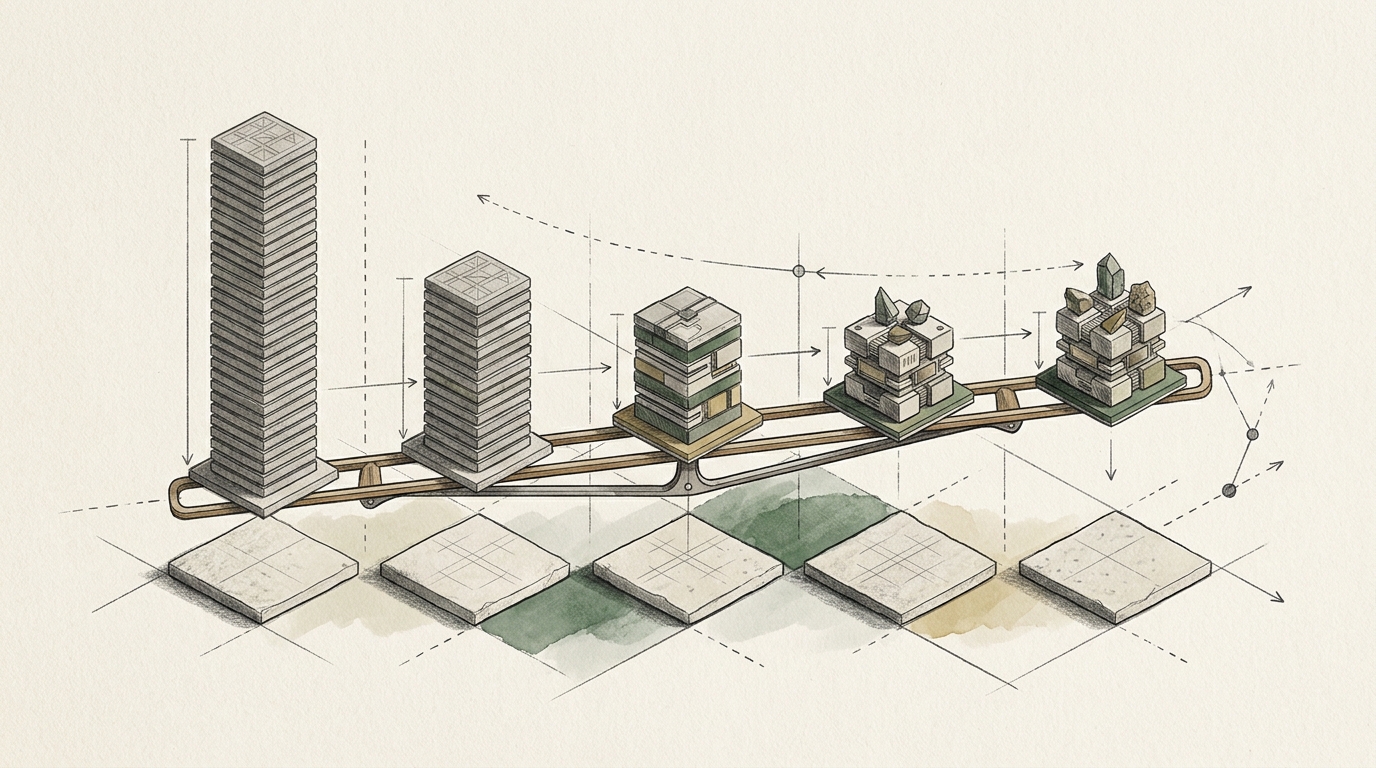
In Canada, custom software generally costs from $35,000 to more than $175,000 CAD to build. A focused internal tool often falls between $35,000 and $80,000, while a platform integrated with several systems is more likely to start around $80,000. These are planning estimates, not universal rates: the actual price depends on the workflow, integrations, data, and risk.
The right decision is not based on build cost alone. It compares five-year total cost of ownership with both the status quo and an existing software product.
Budget ranges for an initial conversation
These Project Factory ranges reflect the typical scope of digital projects in Canada. They help a buyer prepare; they do not replace an estimate after discovery.
- Discovery and prototype: $10,000 to $25,000. Map the workflow, test major risks, and validate the main experience without delivering a complete system.
- Focused internal tool: $35,000 to $80,000. One primary role, one critical workflow, a simple admin interface, and few integrations.
- Integrated multi-role system: $80,000 to $175,000. Several permission levels, payments or notifications, data migration, and connections to existing systems.
- Complex platform: $175,000 and above. A product serving multiple organizations, high availability expectations, mobile or AI capabilities, stronger compliance needs, and many integrations.
A credible estimate also states what is excluded. Content creation, licence purchases, data cleanup, training, and changes requested after approval may belong to separate budgets.
What actually changes the cost
Screen count is a poor shortcut. Two interfaces of similar size can require dramatically different effort when one displays information and the other coordinates sensitive decisions.
The largest cost drivers are:
- the number of user roles and authorization rules;
- the quality and quantity of data to migrate;
- the number of APIs, vendors, or devices to connect;
- workflow exceptions;
- availability, security, and audit requirements;
- web, mobile, and offline environments to support;
- the amount of uncertainty still present at the start.
A smaller first release reduces cost when it removes one manual task from end to end. Randomly cutting essential steps creates cheaper software that cannot replace the old process.
Calculate five-year total cost
Use five categories to compare every option on the same basis.
Build and implementation
Include discovery, design, development, testing, migration, and launch. Existing software can also require implementation, configuration, and migration; buying does not always mean switching it on in a day.
Operations and maintenance
For active custom software, reserving 15% to 25% of the build cost per year is a reasonable planning assumption. It is an estimate, not a standard. It covers updates, monitoring, fixes, and minor improvements, not an entirely new generation of the product.
Add hosting, transactional email, maps, storage, AI models, and other usage-based services.
Subscriptions and growth
For SaaS, project the price using the real number of users, locations, records, or transactions. Check paid modules, API limits, and likely price changes. A product that is inexpensive for ten people may enter another pricing tier at fifty.
Human work that remains
Measure hours spent on duplicate entry, exports, approvals, searches, and corrections. The cheapest software to buy can become the most expensive option when the team keeps working around its constraints every week.
Change management
Budget for training, documentation, support for early users, and a transition period. Adoption is part of the product. An unused feature creates no return even when it was delivered exactly as quoted.
A comparison without a manufactured break-even point
Suppose a subscription costs $2,500 per month after required modules, or $150,000 over five years before increases. Implementation costs $20,000, and the team still spends 15 hours a week on manual handling valued at $45 an hour. That work represents about $175,500 over five years.
The SaaS scenario reaches roughly $345,500 before price increases. A custom tool costing $120,000, followed by $24,000 in annual maintenance and $15,000 in five-year infrastructure, totals approximately $255,000. But custom only wins if it truly removes most of the manual handling and the business can maintain it.
Change three assumptions and SaaS may be the better option again. The model should expose assumptions, not manufacture a favourable verdict.
When buying remains the right decision
Choose an existing product when the process is standard, the vendor covers the important requirements, and your competitive advantage does not depend on that particular operation.
Spiria's guide to packaged and custom software offers a useful distinction: a market solution provides a common capability, while custom becomes relevant when needs specific to the organization justify the investment. In many cases, careful configuration and a small integration are better than rebuilding.
When custom becomes rational
Custom software deserves investigation when:
- the same manual work is expensive and repeats every week;
- fragmented tools produce errors or delays;
- the workflow is genuinely distinctive and stable;
- required integrations are unavailable in existing products;
- the business wants control of its roadmap and data;
- growth would sharply increase per-user or per-transaction pricing.
You do not have to replace everything at once. The incremental approach described by Google Cloud looks for measurable improvement and modernizes in stages. A portal, an integration layer, or one workflow can remove the main bottleneck first.
Include privacy in the budget
In Quebec, the Commission d'accès à l'information says a privacy impact assessment is required for a project to acquire, develop, or redesign an information system involving personal information.
Time spent minimizing data, defining access, documenting flows, and assessing vendors is therefore not a cosmetic extra. It belongs in discovery alongside testing and migration.
Prepare for a useful estimate
Document one real workflow, its monthly volume, the people involved, the current tools, and three measurable consequences. Then separate the capabilities essential to the first result from future improvements.
Project Factory's custom web application development service turns that framing into an operational tool. The Workind project illustrates a platform that centralizes distinct journeys and roles.